Table of Contents
Thinking of switching your home to solar? This guide explains how a household solar panel system works, why output changes with the seasons, and what to consider when comparing installation costs, potential savings and payback.
What does running a house on solar actually look like?
Panels on your roof turn daylight into electricity. An inverter converts the electricity generated by your solar panels into alternating current (AC), the form of electricity used by your household appliances. In a typical system, this electricity is then used in the following order:
1. It supplies appliances running in your home, such as your fridge, router or kettle.
2. Surplus electricity charges your battery, if you have one and it has capacity available, so you can use that energy later.
3. Any remaining surplus is exported to the grid. You may receive payment for this electricity if you have an eligible export tariff.
After dark, your panels no longer generate electricity. If you have a battery with charge available, it can supply your home; the grid provides any additional electricity you need. The system manages these flows automatically, according to your household’s demand, the battery’s charge level and its settings.
How much of your home can solar power?
How much of your electricity use solar can meet depends on both annual generation and when you use that electricity. For a household using around 4,000 kWh a year, a 3–4 kWp system may generate an amount equivalent to roughly 50–70% of annual demand. The unit kWp, or kilowatt-peak, describes the panels’ rated power under standard test conditions. A 3 kWp system might generate around 2,600–2,700 kWh a year, depending on its location, roof orientation and shading. These figures describe generation, not the proportion of household demand actually supplied by solar.
Timing determines how much of that generation you can use at home. Panels generally produce most electricity around the middle of the day, while many households use more in the morning and evening. Without a battery, the illustrative self-consumption range here is 37–45%: the share of solar generation used directly in the home. A 5–10 kWh battery can store surplus electricity for later use, potentially increasing that share to 60–80%. Actual results depend on your electricity-use pattern, system size and the battery’s usable capacity and settings.
That's why going completely off-grid is rare in the UK, and why it doesn't need to be the goal. The aim is to use as much of your own power as you can, and buy less from the grid. We've looked at the question in more depth in Can solar panels really power your home?
Making solar work all year round
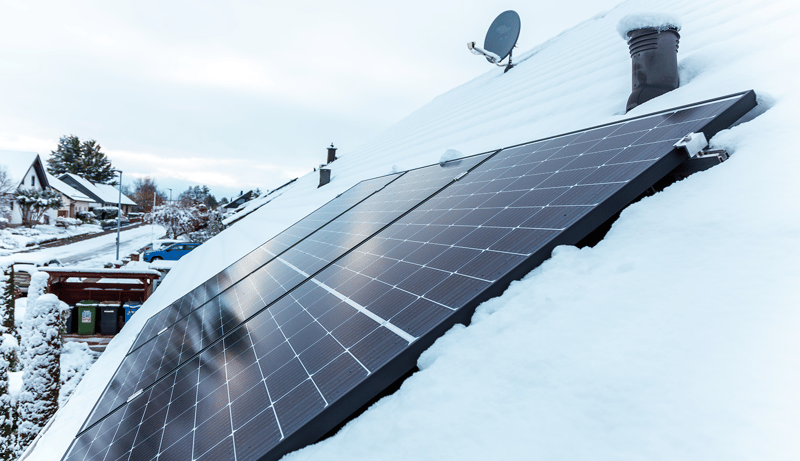
The most common doubt about solar in Britain is the weather. Panels run on daylight, not sunshine, so they keep producing on cloudy days. Winter output can still be two to three times lower than in summer.
Solar households tend to adjust with the seasons:
- In summer, the panels often make more than the house can use. That's the time for energy-hungry jobs, from running the dryer to charging the car.
- In winter, the panels cover less. A battery charged on a cheap overnight tariff can fill some of the gap.
- All year, it's the annual total that counts. Systems are sized for the whole year, not for a single grey day in January.
What it could mean for your bills
The numbers depend on your home, where you live and, above all, how you use your power. Here's where independent sources put them:
- Cost: a typical system costs around £7,500, based on MCS installation data for 2025. Residential installations currently carry 0% VAT.
- Payback: Most households break even in around ten years.
- Lifespan: panels typically last 25 years or more. The inverter usually needs replacing once, after about 12 years.
Here's how that works out for a typical home. This estimate is for a 4.0 kWp, panels-only system on a south-facing roof at 35° in Cardiff (MCS zone 5W):
| Estimated annual output (first year) | 3,606 kWh |
| Used at home / exported | 1,442 kWh / 2,164 kWh |
| Bill saving per year | £380 |
| Export income per year | £260 |
| Total benefit per year | £639 |
| Installation cost | £6,630 |
| Payback | 10.4 years |
Could solar work for your household?
Solar tends to suit homes where a few of these are true:
- You own your home and plan to stay for a few years.
- Your roof gets a good amount of daylight through the day.
- Someone is often home during the day, or you're happy to use timers.
- You'd like more control over your energy bills.
If that sounds like you, the next step is understanding your options.
Where to go next
For many households, the hardest part isn't deciding solar is a good idea. It's knowing who to trust and whether a quote is fair.
That's where Switch Together comes in. Working with councils across the UK, we bring households together to buy solar as a group. Independently vetted installers then compete to offer a competitive price.
You'll get a personal offer based on your home, with no obligation to go ahead. Find out how solar group buying works.