Table of Contents
With energy costs still a concern for many households, solar battery storage is attracting growing interest. From 1 October 2026, the Ofgem price cap puts a typical household’s energy bill at £1,723 a year. A home battery can help you make better use of your solar electricity and, with the right setup, provide backup power during a power cut. But batteries involve an upfront cost, the benefits vary from home to home, and with so many batteries on the market, it can be hard to know where to start.
A home battery is not a one-off purchase. It becomes part of your home’s energy system for the next 10 to 15 years. That’s why it’s worth looking beyond the price – at whether the system suits your home, and whether you can trust the company that installs it.
At Switch Together, we run group-buying schemes for solar panels and battery storage in partnership with local councils. In this guide to solar battery storage in the UK, we explain how it works, the main advantages and disadvantages, and what to consider so you can make a choice you’re happy with in 2026.
What is a solar battery, and how does solar battery storage work?
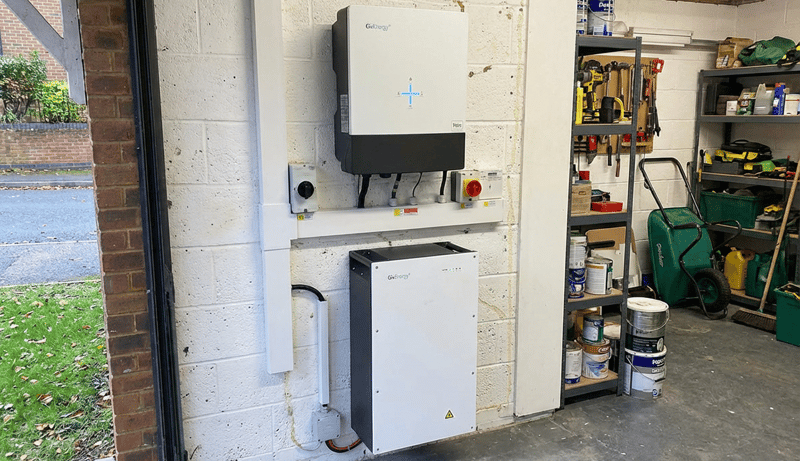
A solar battery (also called a home battery storage system) stores electricity so you can use it later. Your solar panels can charge it during the day, or you can charge it from the grid when electricity costs less.
In a typical home with solar panels, it works like this:
- Your solar panels generate electricity during the day.
- Your home uses what it needs first.
- Any surplus charges the battery.
- In the evening, or when your panels aren’t generating enough, the battery powers your home.
- When the battery is full, any extra electricity goes to the grid. You can be paid for this through the Smart Export Guarantee (SEG) – a government-backed scheme under which certain electricity suppliers pay you for the electricity you export. Rates vary between suppliers.
Battery storage is one of the fastest-growing home energy technologies in the UK. MCS (the Microgeneration Certification Scheme) is the UK’s quality assurance scheme for home renewable energy installations. It recorded more than 40,000 certified home battery installations in 2025 – almost double the previous annual record. That means more than half of all MCS-certified battery installations to date took place in that one year.
Most households choose a battery of 5–10 kWh. Homes that use a lot of electricity in the evening, or that charge an electric vehicle, often choose 8–12 kWh. You can read more on our battery storage page.
Benefits of solar battery storage: two main advantages
A home battery does more than reduce costs. It makes your home more energy independent. We see two main benefits: lower monthly electricity bills and, if your system is set up for it, backup power during a power cut.
1. Lower monthly electricity bills
Solar panels generate most of their electricity in the middle of the day, but most homes use the most electricity in the evening. A battery bridges that gap. It stores your surplus solar power so you can use it after dark or on dull days.
Using stored solar electricity reduces the amount you need to buy from the grid. Under the current price cap, grid electricity costs an average of 26.32p per kWh (1 October to 31 December 2026, paying by Direct Debit). Most export tariffs pay less than this for each unit you send to the grid. So in most cases, using a unit of your own solar power saves you more than exporting it would earn you. Some energy is lost each time a battery charges and discharges, though, so the overall benefit depends on your import and export tariffs.
You can also use a battery with a time-of-use tariff. This type of tariff charges different prices at different times of day, with lower rates at off-peak times such as overnight. You can charge your battery when electricity costs less and use that stored electricity at peak times. Most households save an extra £300 a year by adding battery storage to their solar panels.
2. Battery backup for solar panels in a power cut
If your system is designed for it, a battery can also provide backup power during a power cut. This is not a standard feature of every home battery: you need a battery and inverter with an emergency power supply (EPS) or backup function, installed and wired for this purpose.
As a rough example, a fully charged 5 kWh battery with backup could run a fridge-freezer, a broadband router, a few LED lights and phone chargers (around 350 W in total) for roughly 12 hours. How long it actually lasts depends on the battery’s usable capacity and on what you run.
Do solar panels work in a power cut in the UK? A standard grid-connected system switches off automatically when the grid fails. This protects engineers who are working on the network. If backup is important to you, discuss it with the installer before installation, including which appliances you want it to support. Read more in our guide: Do solar panels work during a power outage?
Power cuts in the UK: what recent storms have shown
The UK grid is generally reliable, but severe storms can leave homes without power for days:
- Storm Arwen (November 2021): nearly 1 million homes in Britain lost power. Ofgem’s review found that nearly 4,000 homes were without power for more than a week.
- Storm Éowyn (January 2025): in Northern Ireland alone, 285,000 households and businesses were affected by power cuts. NIE Networks reported that around 400 customers were still without power on 3 February, more than a week after the storm.
In situations like these, a battery with a backup function can keep selected appliances running, such as your fridge and freezer, lights, broadband and phone charging. If your solar system is designed to keep generating in backup mode, your panels can also recharge the battery during the day. If anyone in your home relies on medical equipment, check with your installer and the equipment supplier whether a backup system is suitable, rather than assuming it will be covered.
Related article: Solar battery price: what does battery storage cost in the UK?
About Switch Together group buying: How our group-buying schemes work
Disadvantages of solar battery storage – and how to deal with them
Home batteries are a great way to make your home more self-sufficient. But there are two main hurdles: the upfront cost, and choosing the right system and installer. If you understand both and make good use of government support and a trusted scheme, you’re well on the way to an installation you’re happy with.
1. The upfront cost (solar battery storage price)
A home battery is a significant investment. According to MCS Dashboard data for 2025, the average fully installed home battery system in the UK costs £6,819. The price depends on the battery’s size and brand, and on how it’s installed – for example, whether you add it to existing panels or fit it together with new ones. It reflects the cost of the battery cells, the inverter and the installation work.
However, as part of the UK’s target to reach net zero by 2050, there is support that can reduce the cost.
Government support
- 0% VAT: battery storage installed in a home is zero-rated for VAT until 31 March 2027. This applies whether you fit the battery with solar panels, add it to an existing system or install it on its own (HMRC).
- Warm Homes Plan: the government’s Warm Homes Plan includes plans for government-backed loans for solar panels and batteries, to be introduced in phases. Its schemes for low-income households will also support measures including solar PV and batteries.
- Regional and local schemes: Scotland, Wales and Northern Ireland each run their own support schemes, and some councils offer extra help.
Eligibility and funding change regularly, so it’s worth checking what is available in your area. See our guide to solar battery grants.
Switch Together group-buying schemes
Our council-backed schemes use the combined buying power of many households to secure competitive prices. Vetted installers bid in an auction to offer the best value and quality, and you then receive a personal recommendation for your home. Registration is free, and you’re under no obligation to accept. Find out how group buying works.
2. Finding an installer you can trust
Battery installers range from large national companies to small local businesses, so comparing them on your own can take time. Our schemes make it easier to compare your options. We check participating installers against clear criteria:
- MCS certification – the UK quality assurance scheme for renewable energy products and installers
- RECC membership – a consumer code that means clear contracts, honest sales practices and a free complaints process
- A proven track record and positive customer feedback
- Insurance and warranties, so you’re covered long after the job is done
We also keep monitoring reviews, response times and service quality, and the batteries come with a 10-year manufacturer warranty as standard. You then receive a personal recommendation based on your home. You can review it and decide whether to accept it, with no obligation to proceed. Learn more about our installers.
With energy prices rising again this winter, and more people looking for ways to use more of their own solar power, solar battery storage is set to become even more popular. At the same time, it’s a significant purchase that you’ll use for 10 to 15 years. So make good use of the support available, and choose an installer you can trust.
Related articles:
- Do solar panels work during a power outage?
- Solar battery installation: what to expect
- Adding a battery to your existing solar panels
Is solar battery storage worth it? Your questions answered
Do I need a solar battery?
Not necessarily. Solar panels work without a battery, and you can add one later. A battery makes most sense if you use a lot of electricity in the evening, export a lot of your solar power, want to use a time-of-use tariff, or want backup power in a power cut (which needs a system with a backup function).
Does a solar battery save money?
In most cases, yes. A battery lets you use more of your own solar power and buy less electricity at peak rates. How much you save depends on how much electricity you use and when, your tariff, and the size of your battery and solar panels.
Is solar battery storage worth it?
It depends on your home. For many homes with solar panels, the savings and the peace of mind over 10 to 15 years make a battery worth it – especially while installation is zero-rated for VAT. A personal recommendation for your home, with estimated savings, is the easiest way to find out.
Summary: how to choose a solar battery you won’t regret
Home batteries are becoming an important part of the modern home. They help with rising energy bills and can keep the lights on in a power cut. But they’re a significant investment, and you’ll use yours for 10 to 15 years or more.
So rather than deciding on price alone, we recommend basing your decision on these three points:
- Choose a capacity that suits your lifestyle: be clear about how much electricity you normally use, and which appliances you want to keep running in a power cut. Check whether you need a backup (EPS) function.
- Keep up to date with the support available: make good use of 0% VAT on battery installations (until 31 March 2027), and keep an eye on support under the Warm Homes Plan.
- Find a partner you can trust: choose an MCS-certified installer with a proven track record, who you can rely on for everything from installation quality to aftercare.
At Switch Together, we work to address each of these concerns, so every household can make a choice it feels confident about.
Installing a battery is an important step towards a more secure energy future for your home. Our expert team is here to help you every step of the way, so if you have any questions, please contact us.
Join the switch: register with Switch Together to receive your free, no-obligation personal recommendation and find out what a battery could do for your home.