Table of Contents
If you're thinking about swapping your gas or oil boiler for an air source heat pump, the first question is usually the simplest one: how does it actually work?
The short answer: an air source heat pump doesn't burn fuel to make heat. Instead, it pulls heat that's already there, out of the outside air, and moves it into your home. It does this using electricity, a refrigerant, and the same basic technology as your fridge, just running in reverse.
That might sound too good to be true. So in this guide, we'll break down exactly how the process works, step by step.
What Is an Air Source Heat Pump?
An air source heat pump is a heating system that extracts heat from the outdoor air and transfers it into your home to warm your radiators, underfloor heating, and hot water.
Here's the process in a nutshell:
- A fan draws outside air over a cold refrigerant, which absorbs the heat and evaporates.
- A compressor squeezes that refrigerant, which raises its temperature further.
- The hot refrigerant passes through a heat exchanger, releasing its heat into your home's water system.
- The refrigerant cools and expands, ready to absorb more heat, and the cycle starts again.
Even on a chilly day, there's still plenty of heat energy in the outside air for this to work. Unlike a boiler, the heat pump doesn't create heat from scratch, it just moves it from one place to another, which is why it can deliver more heating energy than the electrical energy it uses. We'll come back to exactly why that matters for your bills later on.
How Air Source Heat Pumps Work, Step by Step
To really understand how an air source heat pump works, it helps to think of it as a fridge working backwards. A fridge takes heat from inside its cabinet and dumps it into your kitchen. An air source heat pump takes heat from the air outside and dumps it into your home.
This happens through what's called the refrigerant cycle, a loop that repeats continuously while the heat pump is running. According to the UK Parliament's own research briefing on heat pumps, the cycle works in four stages (UK Parliament POST, Heat Pumps):
The Refrigerant Cycle Explained
- Evaporation: Outdoor air is blown over a network of pipes containing a special fluid called refrigerant. This refrigerant has a very low boiling point, so even air at a few degrees above freezing is warm enough to make it evaporate into a gas.
- Compression: That gas is pulled into a compressor, which squeezes it under high pressure. Just like a bicycle pump gets warm when you use it, compressing a gas raises its temperature significantly, this is the step that does the real "heating" work, and it's the only step that needs electricity.
- Condensation (heat transfer): The now hot, high-pressure gas passes through a heat exchanger next to your home's water system. It releases its heat into the water, which is pumped around your radiators, underfloor heating, or hot water cylinder. As it gives up its heat, the refrigerant cools and turns back into a liquid.
- Expansion: The liquid refrigerant passes through an expansion valve, which drops its pressure and temperature right down, ready to absorb heat from the outside air again. The cycle then repeats.
Key Components
Every air source heat pump relies on the same core parts to make this happen:
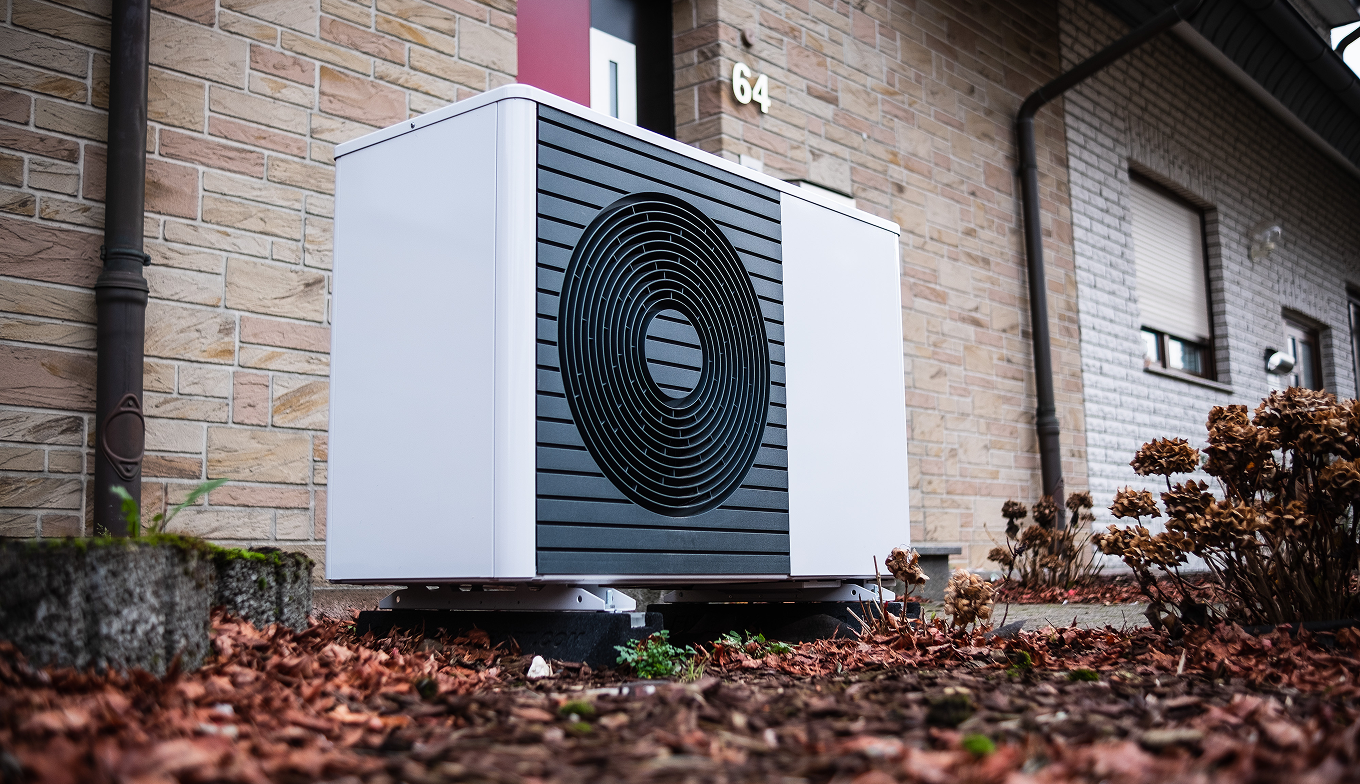
- Outdoor unit (evaporator and fan): Draws in outside air and lets the refrigerant absorb its heat.
- Compressor: Raises the refrigerant's pressure and temperature; this is the "engine" of the system.
- Heat exchanger (condenser): Transfers heat from the refrigerant into your home's water system.
- Expansion valve: Resets the refrigerant's pressure and temperature so the cycle can begin again.
For a broader look at how this compares to other technologies, our guide to types of heat pumps covers air-to-air, air-to-water, and ground source systems side by side.
Monobloc vs Split System: Two Ways to Build the Same Cycle
Not every air source heat pump looks the same on the outside, even though the refrigerant cycle inside is identical. There are two main designs, as manufacturer Dimplex explains in its technical guidance (Dimplex, Monobloc vs split system air source heat pumps):
- Monobloc: The entire refrigerant cycle, including the compressor, happens inside the outdoor unit. Only water pipes (not refrigerant pipes) run into the house. This is the simpler, more common choice for UK home retrofits.
- Split system: The compressor stays outside, but refrigerant pipes run to a separate indoor unit, where the final heat transfer happens. This can be more efficient in some setups but needs a specially qualified installer to handle the refrigerant safely.
For most UK homeowners switching from a gas or oil boiler, a monobloc system is the more straightforward option, and it's what most MCS-certified installers will recommend as a default.
How an Air Source Heat Pump Heats Your Home and Hot Water
Once the heat has been transferred into your home's water system, it needs somewhere to go. Air source heat pumps typically heat your home in three ways:
- Radiators: Heat pumps work best with larger radiators, or more of them, because they run at a lower water temperature than a gas boiler. A bigger surface area makes up for the gentler heat.
- Underfloor heating: This is a natural match for heat pumps, since underfloor systems are already designed to run at lower temperatures and heat a room gradually and evenly.
- Hot water cylinders: Most heat pump installations include a hot water cylinder, which stores water heated by the pump ready for your taps and shower.
This is also why insulation matters so much when you're considering a heat pump. A well-insulated home holds onto heat delivered at a lower temperature far more effectively, which keeps your system running efficiently. If you're weighing this up against sticking with your current setup, our comparison of a heat pump vs a boiler walks through what changes in practice.
Ready to find out if an air source heat pump is right for your home?
Now that you know how they work, the next step is finding out what one would cost, and save you, in your specific home. Explore air source heat pump installation with Switch Together to compare vetted, MCS-certified installers.