Table of Contents
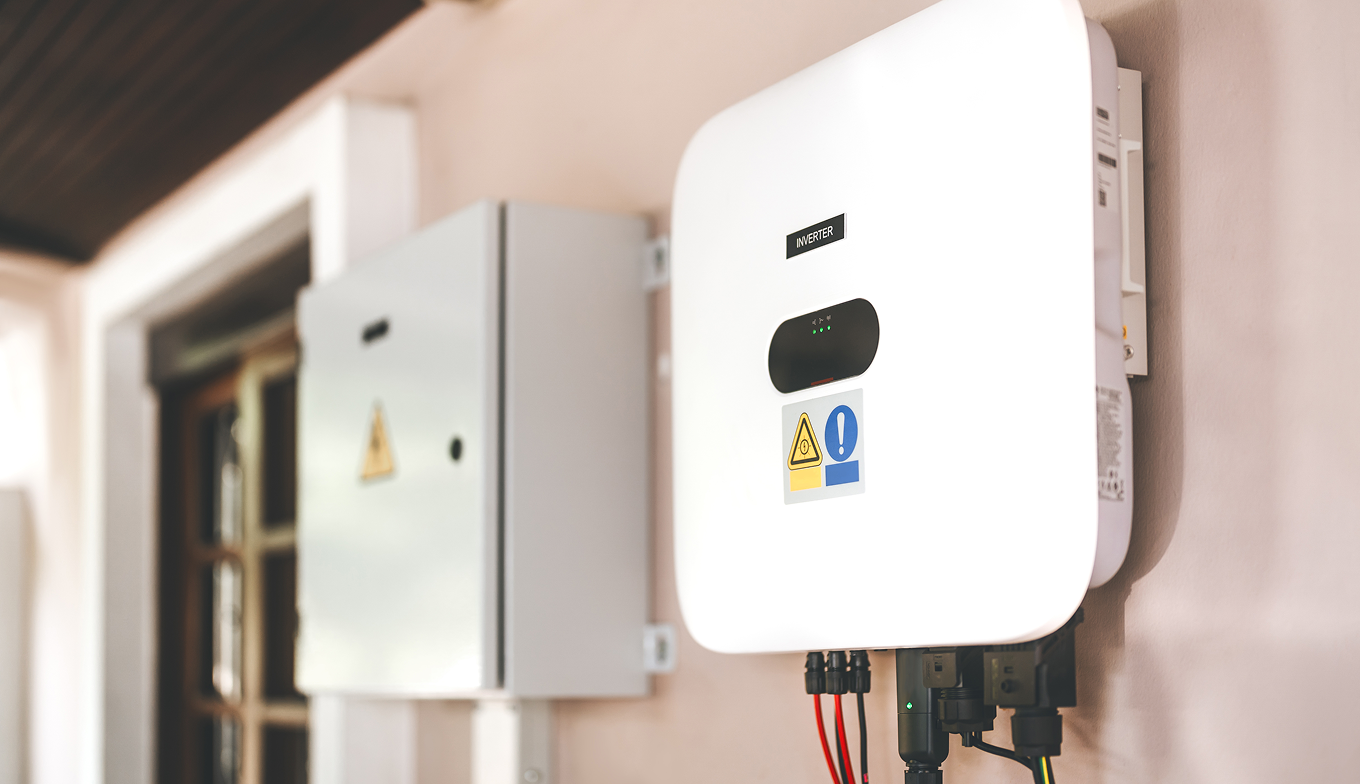
A solar inverter is the piece of equipment that turns the electricity your solar panels produce into electricity you can actually use. Panels generate direct current (DC), but the sockets, appliances, and grid in your home run on alternating current (AC) — the inverter is what makes that conversion happen. Without it, a solar panel system can't power your kettle, your lights, or anything else in the house.
It's easy to think of the inverter as a small, unglamorous box bolted to a garage wall, but it's doing more than one job. As well as converting DC to AC, it constantly adjusts itself to squeeze the most power out of your panels as the sunlight changes throughout the day, and it watches the grid to make sure it only ever exports power safely. If your solar panels are the part of the system that gets the attention, the inverter is the part that makes them useful.
What does a solar inverter actually do?
A solar inverter converts the variable DC electricity produced by your solar panels into stable, utility-frequency AC electricity — 230V at 50Hz in the UK — so it can run your appliances or be exported to the grid.
And it comes with two extra responsibilities that matter just as much as the conversion itself. First, it optimises: panel output rises and falls with cloud cover, shading, and the sun's position, and the inverter continuously adjusts to pull the maximum power available at any given moment. Second, it protects: it monitors the condition of the grid connection and instantly disconnects your system if something's wrong, so it never exports electricity into a grid line that's down for repair.
How does a solar inverter turn DC into AC?
The inverter uses electronic switches to chop up the DC electricity thousands of times a second, shaping the result into a smooth AC wave. Here's what that looks like in a typical home system:
How it works- DC comes in from the panels. Your panels are wired together into one or more "strings," producing a DC voltage that falls within the range the inverter is built to handle.
- The voltage is conditioned. Many inverters first pass this DC through a stage that raises and steadies the voltage, getting it into the right range for the next step and enabling maximum power point tracking (MPPT) — the process that keeps the panels operating at their most efficient point as light conditions shift.
- Electronic switches convert DC to AC. Fast-switching semiconductors flip the DC on and off in a precise pattern (known as pulse-width modulation) to build up an AC waveform.
- Filters smooth the output. That raw waveform gets filtered to remove electrical noise, so what reaches your consumer unit is a clean sine wave rather than a rough, stepped signal.
- The inverter synchronises with the grid. Voltage, frequency, and phase are matched to the grid before any export happens, and the system disconnects automatically if the grid goes down — a safety feature called anti-islanding.
Modern inverters typically convert DC to AC at 95–98% efficiency, meaning very little of the energy your panels generate is lost in the process. The two or three per cent that doesn't make it through is given off as heat, which is one reason inverters need ventilation and, in hotter installations, can run warm to the touch.
Where does the inverter sit in your solar panel system?
The electricity in a typical grid-connected home system flows in one direction, through a fixed sequence: panels generate DC, that DC runs down to the inverter, the inverter converts it to AC, and the AC feeds into your consumer unit (fuse box) to power your home, with anything you're not using exported to the grid.
Inverters are usually installed somewhere cool, dry, and easy to access for maintenance — a garage, a utility room, or an external north-facing wall are all common choices, since keeping the unit out of direct sun helps it run efficiently.
What types of solar inverter are there?
Not every home uses the same kind of inverter, and the type installed affects cost, performance in shade, and how well the system copes if a single panel underperforms.
String inverters
One central inverter handles the combined output of a whole "string" of panels. This is the most common and most affordable setup for a straightforward, unshaded roof, but because all the panels in a string share one inverter, a problem with the weakest panel — like a small patch of shade — can drag down output for the whole string.
Microinverters
Instead of one central unit, each panel gets its own small inverter, converting DC to AC right at the panel. This means shading or a fault on one panel only affects that panel, not the whole array — a real advantage on roofs with chimneys, dormers, or trees casting partial shade. The trade-off is a higher cost, since you're buying and installing several small units instead of one.
Hybrid inverters
A hybrid inverter does everything a standard inverter does, plus it manages a home battery — controlling when the battery charges from excess solar and when it discharges to cover your home's demand. This is the fastest-growing and most-searched category of solar inverter in the UK right now, and it deserves a closer look on its own: see our full guide to hybrid solar inverters for how they work and when it is worth it.
What size inverter do you need?
As a rule of thumb, most UK systems use an inverter rated at around 80–90% of the total capacity of the solar array — a 4kW system, for example, is commonly paired with a 3.6kW inverter, since panels rarely produce their full rated output simultaneously. Getting the size right affects both performance and (for larger systems) which grid-connection paperwork applies.
The right size depends on your exact panel count, orientation, and whether you're adding a battery.
How long do solar inverters last, and what do they cost?
Most solar inverters are built to last 10–15 years — roughly half the working life of the solar panels themselves, which is why most homeowners will replace their inverter at least once during the life of their system. String inverters and hybrid inverters typically fall within this range, while microinverters, with no single point of failure across the whole array, are often warrantied for closer to 20–25 years.
On cost, a straightforward string inverter replacement for a typical UK home system often runs from a few hundred pounds depending on capacity and brand, with hybrid inverters costing more due to their added battery-management electronics. For a full breakdown by inverter type and installation scenario, see our guide to solar inverter costs and our inverter lifespan and replacement guide.
If you're comparing specific manufacturers, our guide on solar inverter brands in the UK covers reliability, warranty length, and app quality across the major names homeowners ask about.
Solar inverter FAQ
Do I need an inverter if I have solar panels?
Yes, in almost every domestic setup. Solar panels produce DC electricity, and every appliance in your home, along with the grid itself, runs on AC — without an inverter to make that conversion, the electricity your panels generate has nowhere useful to go. The only common exception is a small, dedicated DC system (like a DC-only water pump), which is rare in residential installations.
What's the difference between a solar inverter and a normal power inverter?
A standard power inverter — the kind used with a car battery or a portable generator — simply converts a fixed DC input into AC. A solar inverter does that plus a lot more: it continuously tracks and adjusts to the variable output of your panels via MPPT, and it synchronises and communicates with the electricity grid so it can export power safely and legally.
Can a solar inverter work at night or without the grid?
No — with no sunlight, there's no DC power for the inverter to convert, so a standard grid-tied inverter goes idle overnight. During a power cut, grid-tied inverters are also required to shut off automatically for safety, even if it's daytime and your panels are producing power; only systems with battery backup and the right hybrid inverter can keep supplying electricity when the grid goes down.
How do I know if my inverter is working properly?
Most inverters show their status through a light or display on the unit itself, plus a monitoring app that shows live and historical output. A steady green light and generation figures that broadly match what you'd expect for the weather are good signs; a red or amber light, an error code, or a sudden drop in reported output are worth investigating.
What's the difference between a solar inverter and an optimiser?
A power optimiser sits between each panel and a central inverter, conditioning that panel's DC output individually — similar to what a microinverter does — but it still relies on one central inverter to actually convert the power to AC. It's often described as a middle ground: better shading performance than a plain string inverter, at a lower cost than full microinverters.