Table of Contents
Heat pumps are often discussed in terms of grants, lower emissions, and long-term savings.
Below are nine air source heat pump disadvantages worth understanding before you make a decision.
The 9 main air source heat pump disadvantages
1. Higher upfront installation cost
A typical UK installation runs from roughly £7,000 to £16,000, depending on the size of your home, the system you choose, and how much groundwork (radiators, pipework, a hot water cylinder) is needed alongside it. The Boiler Upgrade Scheme can currently knock a substantial chunk off that — up to £7,500 for homes moving off gas or electric heating, or £9,000 for homes moving off oil or LPG — but the grant doesn't cover everything, and eligibility rules apply. See current heat pump prices for a fuller breakdown.
2. Running costs depend on your electricity price
Whether a heat pump actually costs less to run than a gas boiler depends on a specific number — its seasonal performance factor (SPF) — measured against the current gap between electricity and gas prices.
Under the Ofgem price cap running from 1 July to 30 September 2026, the GB Direct Debit averages are 26.11p per kWh for electricity and 7.33p per kWh for gas — a ratio of about 3.56:1 (Ofgem; recheck this before you buy, as the cap updates every quarter). At those rates, here's what a unit of useful heat actually costs, once you account for how efficiently each system turns fuel into warmth:
|
System |
Cost per useful kWh of heat |
|---|---|
|
Direct electric heating (COP 1.0) |
26.11p |
|
Heat pump at SPF 2.94 (real-world median — see below) |
8.88p |
|
Heat pump at SPF 3.5 (well-installed system) |
7.46p |
|
Modern gas boiler (90% efficient) |
8.14p |
Do the maths, and a heat pump needs a real-world SPF of around 3.21 to beat a modern gas boiler on fuel cost alone. Many well-installed systems clear that bar comfortably — but the median SPF measured in a large UK field trial (more on that below) was 2.94, just under it. That's not a reason to rule a heat pump out; it's a reason to care about installation quality and insulation, which is exactly what determines which side of that line your system lands on. If you remove gas entirely, you also drop the gas standing charge (currently averaging 29.04p a day), which a household keeping a gas hob or boiler can't do.
A few energy suppliers offer heat pump-specific time-of-use tariffs that can help further, though the saving isn't automatic — it depends on a smart meter and being able to shift heating into cheaper hours. Octopus Cosy discounts eight hours a day by 51% (with a pricier peak window from 4–7pm) and estimates around £82 a year in savings for a typical user; EDF's Heat Pump Tracker discounts six hours a day and estimates around £146 a year; British Gas's Heat Pump Tariff halves the unit rate for ten hours a day. Those are supplier estimates, not guarantees.
3. Efficiency drops in colder weather and with higher flow temperatures
You'll often see a heat pump's efficiency described with a single number — its coefficient of performance, or COP: the amount of heat delivered divided by the electricity used, at one specific operating point. COP falls as outdoor air gets colder, but it falls just as much when the system has to supply hotter water to your radiators or hot water cylinder. A claim like "COP is 2.5 at −5°C" is incomplete without knowing the water temperature too — the same outdoor condition at a 35°C flow temperature and a 55°C flow temperature can give very different results.
Illustrative manufacturer data from former DECC/Energy Saving Trust technical evidence shows exactly how much flow temperature matters, for one typical air source heat pump:
|
Outdoor air / flow-water condition |
COP |
|---|---|
|
7°C air / 35°C flow |
4.39 |
|
7°C air / 45°C flow |
3.69 |
|
7°C air / 55°C flow |
3.18 |
|
2°C air / 35°C flow |
3.84 |
|
2°C air / 45°C flow |
3.28 |
|
−7°C air / 35°C flow |
2.65 |
(Source: DECC/EST heat pump field trials.)
For a more realistic year-round picture, look at seasonal performance factor (SPF) rather than a single COP reading. Across 484 monitored UK installations, the Energy Systems Catapult's Electrification of Heat programme found a median system COP of 2.44 on the coldest day monitored (average outdoor temperature −0.4°C), and a median seasonal SPF of 2.94 across 291 systems over a full measured period.
In plain terms: a direct electric heater has a COP of about 1 (one unit of electricity makes one unit of heat). A heat pump running at a seasonal SPF of around 2.9 makes roughly three times as much useful heat per unit of electricity. A modern condensing gas boiler is typically modelled at about 90% efficiency. Heat pumps aren't automatically "three times cheaper to run," though, because electricity costs more per kWh than gas — running cost depends on both the SPF and the price gap between the two fuels, as the table above shows.
4. Not every home is "heat-pump-ready"
Most UK homes can run a heat pump, but not every home is ready on day one.
Mythbuster: "Half of UK homes can't have a heat pump"
You may have seen a claim that only around half of UK homes are suitable for a heat pump. This claim stems from a 2021 report by the Energy and Utilities Alliance, Decarbonising heat: Putting consumers first, which estimated that 8–12 million homes might need upgrades for heat pump-only heating.
But new evidence points the other way. Nesta reports that government data indicate 80–90% of UK homes already have enough insulation to run a heat pump. The government's own heat pump investment roadmap similarly points to around 90% of British homes having sufficient insulation and electrical capacity.
What actually determines whether your specific home is ready is a shortlist of practical factors:
|
Factor |
What it determines |
|---|---|
|
Heat loss and insulation |
A leaky home can still have a heat pump, but may need a larger system, a higher flow temperature, bigger emitters, or a higher running cost. Draught-proofing and insulation reduce all of these. |
|
Radiators or underfloor heating |
Whether each room's heat loss can be met at a lower flow temperature. Bigger radiators, fan-assisted emitters or underfloor heating allow lower flow temperatures and better efficiency. |
|
Existing pipework and controls |
Pipe sizing, layout, zoning and weather compensation affect whether the system can run as designed. |
|
Outdoor unit location |
Needs airflow, service access, condensate drainage, sensible acoustic siting and a planning-compliant spot (more on this below). |
|
Indoor space |
Most systems need room for a hot water cylinder; removing one for a combi boiler can make a later switch harder. |
|
Electrical capacity and permissions |
Electrical supply or network operator approval can be needed, and tenure, leasehold consent or listed-building status can affect whether a project goes ahead. |
For most homes, the honest answer is: probably capable, possibly not optimised yet. That's a very different message from "half of homes can't have one."
5. Radiators or underfloor heating may need upgrading
This is a design question, not a yes/no barrier. Older evidence from a government-commissioned study estimated that on a peak winter day, around 10% of UK homes could run a 55°C-flow heat pump with no changes to their existing radiators — but only around 1% could do so at a lower, more efficient 45°C flow temperature. That's dated evidence and not a verdict on your specific home or on newer, higher-temperature-capable systems, but it explains why an installer might recommend swapping a few radiators for larger ones, rather than replacing the whole system.
6. Heat pumps warm your home more slowly than a gas boiler
A gas boiler is built to blast out heat quickly, then switch off. A heat pump is designed to do the opposite: run for longer periods at a lower, steadier output, gently maintaining a comfortable temperature rather than reacting to it. That's a genuine change in how your home feels day to day, and it's a real adjustment if you're used to whacking the heating on for twenty minutes before you get up. It isn't a fault in the system — it's simply a different way of heating a home, and one that smart controls and weather compensation can help you settle into.
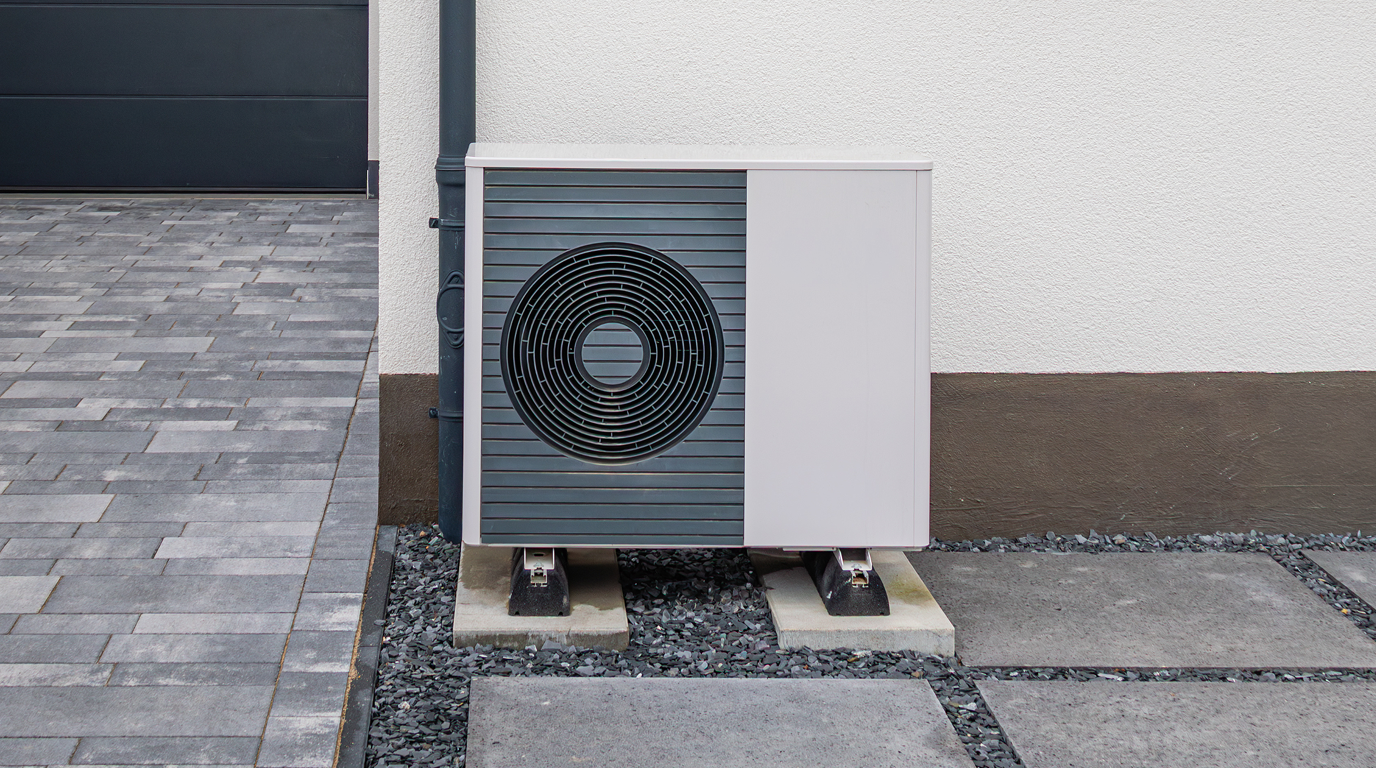
7. The outdoor unit needs space, and isn't silent
You'll often see "40–50 dB(A) at one metre" quoted as a blanket noise figure for heat pumps. It's a reasonable ballpark for sound pressure — what you'd actually hear standing nearby — but it varies by model, output, compressor speed, and whether the unit is mid-defrost. It's also easy to confuse with sound power, a different measurement describing the unit itself rather than what's audible at a distance; the two shouldn't be compared directly. As a real example, Vaillant's aroTHERM plus leaflet lists a 5kW unit's sound pressure at 46 dB(A) at one metre, dropping to 36 dB(A) at three metres and 32 dB(A) at five — while its sound power rating for the same range is a higher 54–60 dB(A) (Vaillant). For an accurate answer for your own home, ask for the manufacturer's sound-power data and your installer's site-specific noise calculation, rather than relying on a single generic number.
8. There's a learning curve to living with one
Weather compensation, smart thermostats, and running the system continuously rather than in short bursts all take some getting used to. Most people adjust within the first heating season, but it's worth going in expecting a settling-in period rather than an instant, boiler-like experience from day one.
9. A few installations need planning permission
Most air source heat pumps in England go ahead under "permitted development" — meaning no separate planning application — but only if every condition is met. (Planning is devolved, so if you're in Scotland, Wales or Northern Ireland, the rules differ and are worth checking separately.)
In England, permitted development requires: the installation to meet the MCS 020(a) noise standard (the sole recognised route from 28 May 2026); the outdoor unit to be no larger than 1.5m³ on a house, or 0.6m³ on a block of flats; only one heat pump for most homes and flats (a detached house can have two); none within the curtilage of a listed building or a scheduled monument; restrictions on wall and roof placement in conservation areas and near a highway; and no installation on a pitched roof, with flat-roof units set back at least a metre from the edge. The MCS 020(a) noise test itself sets a calculated limit of 37.0 dB(A), assessed one metre from the nearest neighbouring doors and habitable-room windows — not, as it's sometimes simplified, "37 dB one metre from the unit" (Planning Portal; MCS 020(a)).
Even where all of that is met, local Article 4 directions, planning conditions, or lease and freeholder restrictions can still apply — so for anything marginal, it's worth asking your installer for the MCS 020(a) calculation and checking with your local planning authority.
Air source heat pump pros and cons, side by side
|
Pros |
Cons |
|---|---|
|
Roughly 3x more useful heat per unit of electricity than direct electric heating, at a typical real-world SPF |
Higher upfront cost than a like-for-like boiler swap |
|
Lower running emissions than gas, oil or direct electric heating |
Running cost advantage over gas isn't automatic — depends on SPF and the electricity/gas price gap |
|
Long lifespan (often 20+ years) and low maintenance versus a boiler |
Efficiency falls in cold weather and with high flow temperatures |
|
Safer than combustion heating — no on-site gas or oil burning |
Outdoor unit needs space, and produces some noise |
|
Works well alongside solar panels and battery storage |
Warms your home more slowly and steadily, rather than in quick bursts |
|
Can be combined with heat pump-specific tariffs for cheaper off-peak running |
A few installs need planning permission or emitter upgrades |
So — are air source heat pumps any good?
For most reasonably insulated UK homes, yes — with the caveats above in mind. Heat pumps tend to make the most sense for households moving off oil, LPG or old direct electric heating, homes that can access the Boiler Upgrade Scheme grant, and properties that already have (or can reasonably get to) a decent insulation standard.
They're a harder call for older, poorly insulated homes without much budget for fabric upgrades, or properties where there's genuinely nowhere sensible to put an outdoor unit. Neither of those situations rules a heat pump out on its own, but they're worth being honest with yourself about before you commit.
What actually helps with these disadvantages
Making the upfront cost smaller. The Boiler Upgrade Scheme grant is the biggest single lever — see current grant amounts and our guide to applying. Beyond that, group buying gives you access to competitively priced, vetted installers without having to chase quotes yourself — potential savings, and they'll depend on your home and system. A heat pump-specific tariff can also trim running costs slightly, though as above, that's a smaller and less certain lever than the installation itself.
Reducing the risk of a badly-sized system. Several of the disadvantages above — poor cold-weather performance, noisy operation, undersized radiators — usually trace back to sizing or installation quality rather than the technology itself. Working with an MCS-accredited, independently vetted installer is what actually reduces that risk: it's also what gets you a proper MCS 020(a) noise calculation and a system designed for your home's real heat loss.
If you want to see what that looks like for your own home, explore how group buying works — there's no obligation, and it's a reasonable next step whether or not a heat pump ends up being right for you.
Frequently asked questions
What are the disadvantages of an air source heat pump?
The main ones are a higher upfront cost than a boiler swap, running costs that depend on your home's efficiency and the electricity-to-gas price gap, reduced efficiency in cold weather or at high flow temperatures, the possible need for larger radiators, some outdoor unit noise, and a few cases requiring planning permission. None of these are dealbreakers on their own — see the full breakdown above.
Are air source heat pumps any good in the UK?
For most reasonably insulated homes, yes. Government data suggests 80–90% of UK homes already have enough insulation to run one, though "capable" and "fully optimised without any changes" aren't quite the same thing — your own home's radiators, insulation and outdoor space are what actually decide it.