Table of Contents
When people look into getting a heat pump, the hot water question is almost always the one that trips them up.
How does it heat the water? Do you need a new tank? What happens to your showers? It's the part that feels most unfamiliar — especially if you've always had a combi boiler and never had to think about a water cylinder before.
The good news: it's simpler than it sounds. This guide explains exactly how a heat pump water heater works, whether you need a new cylinder, what size you'll need, and what to expect from the installation.
How Does a Heat Pump Heat Your Water?
An air source heat pump doesn't work like a gas boiler. It doesn't burn fuel to create heat — instead, it moves heat that already exists in the outside air into your home.
It's worth noting upfront: only air-to-water heat pumps provide hot water. Air-to-air heat pumps (which heat the air in your rooms directly, like a warm air system) don't connect to a water circuit at all and can't supply your taps, showers, or radiators. When we talk about heat pump water heaters in a UK home context, we mean air-to-water.
What Is an Air-to-Water Heat Pump?
The type of heat pump used in most UK homes — and the only type that heats your water — is an air-to-water heat pump. Here's how it works:
The outdoor unit absorbs heat from the outside air (yes, even in winter — there's heat in the air down to around -20°C). That heat is passed through a refrigerant circuit to a heat exchanger inside your home. The heat exchanger transfers energy into your central heating water. That heated water then circulates through your radiators and into a hot water cylinder, where it's stored and available for your taps and showers.
What Temperature Does a Heat Pump Heat Water To?
Heat pumps typically heat water to 45–55°C. Some systems run a bit higher (up to ~58–60°C) depending on design, emitter sizing, and manufacturer settings. This is slightly lower than a gas boiler, which usually runs at 60–80°C, but it's the right temperature for an efficiently designed heat pump system.
Your taps and showers mix this hot water with cold water to reach a comfortable temperature — and because heat pumps produce a generous volume of stored hot water, most households report equivalent or better day‑to‑day hot‑water availability when the system is correctly designed and sized. The system also runs a weekly cycle that heats the water to 60°C+ for safety reasons (more on that below).
Do You Need a Hot Water Cylinder with an Air Source Heat Pump?
For most UK homes: yes. And this is where heat pumps differ most from combi boilers.
A combi boiler heats water on demand — you turn on the tap, and it fires up instantly. A heat pump works differently: it heats water gradually and stores it in a cylinder, ready to use when you need it. The cylinder is the hot water reservoir that makes this possible.
There's no getting around it: if you switch to a heat pump, you need a hot water cylinder in the picture somewhere. The question is whether you need a new one.
If You Currently Have a Combi Boiler
If your home has a combi boiler — no hot water cylinder, no tank — you will need a new hot water cylinder installed as part of your heat pump installation.
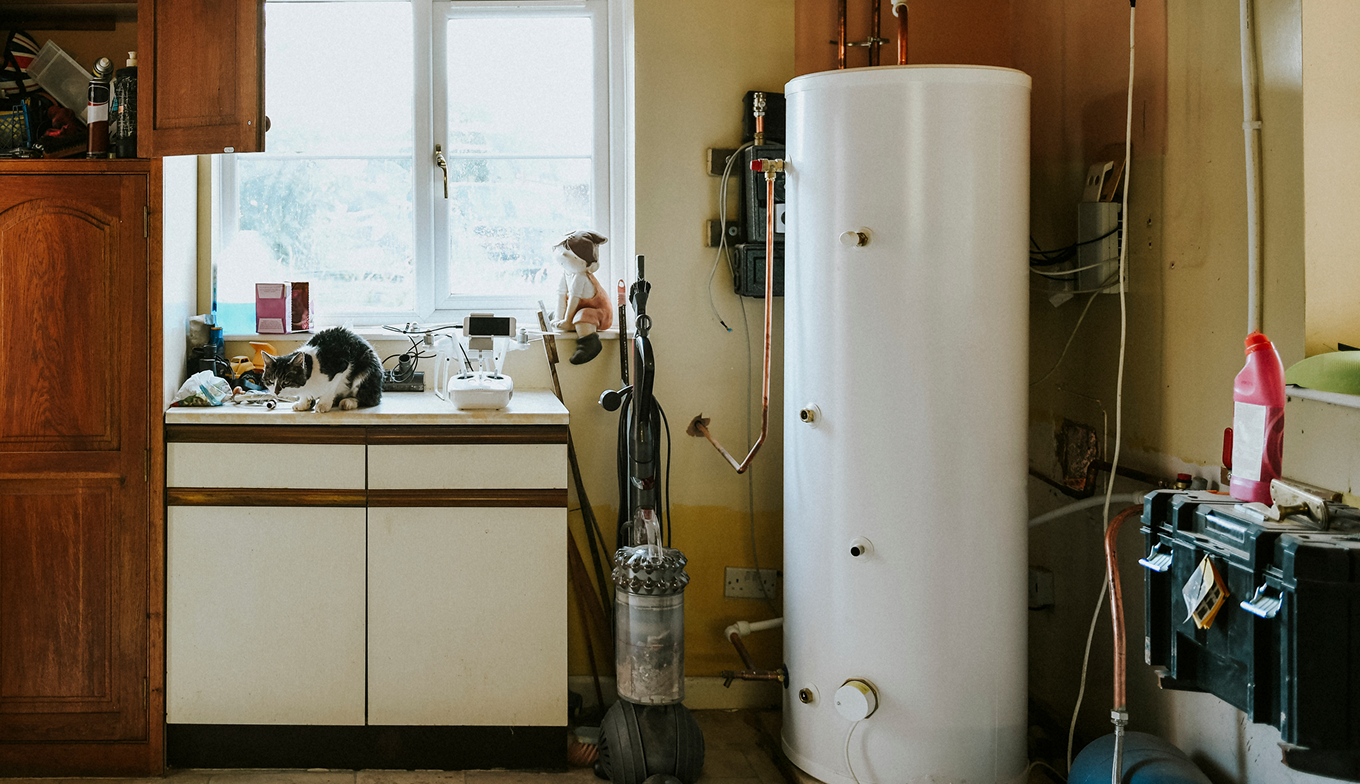
This is one of the most significant practical changes for combi households. Space needs to be found: typically an airing cupboard, utility room, or ground-floor cupboard. A standard heat pump cylinder is roughly 1.5–1.8 metres tall and 45–60 centimetres in diameter — about the size of a tall fridge.
Most homes can accommodate a cylinder without structural changes, and your installer will plan the location during the home survey stage. At Switch Together, cylinder installation is included in your standard installation package.
If You Currently Have a Regular or System Boiler
If you already have a hot water cylinder, you might not need to replace it — but it depends on the cylinder's heat exchanger coil.
Heat pumps operate at higher water flow rates than traditional boilers, and older cylinders often have a small coil that can't transfer heat efficiently enough. In most cases, replacing the existing cylinder with a purpose-built heat pump cylinder (which has a larger coil surface area) is recommended to get the best efficiency from the system.
Your installer will assess this at the home survey. Sometimes an existing cylinder is compatible; often it isn't. Either way, you'll know upfront before committing.
Quick Reference: Do You Need a New Cylinder?
|
Your current setup |
Need a new cylinder? |
Notes |
|---|---|---|
|
Combi boiler (no cylinder) |
Yes |
Space planning required — included in Switch Together install |
|
Regular/system boiler with older cylinder |
Likely yes |
Old coil usually too small for heat pump flow rates |
|
Recent cylinder with large coil |
Possibly no |
Installer will check compatibility at survey |
|
Hybrid heat pump system |
Depends |
May use existing boiler for hot water — discuss with installer |
What Size Hot Water Cylinder Do You Need?
Heat pump cylinders are larger than standard cylinders, and for good reason: heat pumps heat water more slowly than gas boilers, so you need a bigger reserve to cover peak demand (the morning rush, for example).
As a general guide:
- 1–2 people: 180–210 litres
- 3–4 people: 250 litres
- 5+ people or high usage: 300 litres
Your installer will size the cylinder properly based on your household, your hot water habits, and your heat pump's output — so these are starting points, not fixed rules.
One thing worth knowing: because a heat pump typically runs for longer, more continuous periods than a boiler, the cylinder is kept topped up throughout the day rather than being drained and refilled. In practice, many households find they have more reliable hot water with a heat pump than they did before.
What About the Legionella Cycle?
This is the question that catches people off guard — and it's worth addressing directly to avoid surprises.
Heat pumps usually keep your hot water at 45–55°C. That's perfectly comfortable for showers and taps, but a little cooler than a gas boiler. To keep your water safe from bacteria like legionella, your system runs a short, automatic boost about once a week (usually overnight), heating the cylinder to 60°C or above for a short time.
You don't need to do anything. It's all handled by the system's settings, and it's a standard part of every MCS-certified heat pump installation.
Because the boost only runs for a short time, it adds very little to your energy use, and it's already included in typical heat pump running cost estimates.
Will I Have Enough Hot Water?
Yes — provided the system is properly designed and the cylinder is correctly sized.
This is one of the most common worries people have, and it's almost always unfounded in practice. A well-specified heat pump and cylinder combination gives you equivalent or better hot water than a gas boiler system. The stored volume means you're drawing from a large reservoir, not waiting for the system to heat up on demand.
The National Energy Foundation notes that heat pumps can provide domestic hot water, but because they heat more slowly than boilers, reliable supply depends on appropriate hot‑water storage and system design. Switch Together customers regularly report that their hot water supply feels unchanged — or improved — compared to their previous boiler.
The key phrase throughout this is: correctly installed and sized. This is why a home survey matters: a system designed specifically for your household, rather than a one-size-fits-all setup, is what delivers reliable hot water every time.
Is the New Cylinder Included in the Installation?
With Switch Together: yes. The hot water cylinder is included in a standard Switch Together heat pump installation.
This matters because many heat pump quotes you'll see elsewhere present the unit price only, and the cylinder, pipework, and additional components appear as extras that push the final cost up significantly.
Switch Together's prices (visible on the heat pump price page) reflect the full installed system: outdoor unit, hot water cylinder, all standard pipework and fittings, and the labour to put it all together. There's no ambiguity.
If your home survey reveals that something unusual is required — a custom cylinder location, for example, or significant additional work — that will be discussed with you upfront, before you commit to anything.
Frequently Asked Questions About Heat Pump Hot Water
Can a heat pump replace a combi boiler?
Yes, for both heating and hot water. You'll just need a hot water cylinder, which is included in a Switch Together installation. See 'If You Currently Have a Combi Boiler' above for more detail.
Will my existing hot water cylinder work with a heat pump?
Possibly, but many older cylinders have a coil that's too small to work efficiently with a heat pump. Your installer will check yours at the home survey. See 'If You Currently Have a Regular or System Boiler' above for more detail.
How long does it take a heat pump to heat a cylinder of water?
Heating a 200-litre cylinder from cold typically takes 1–2 hours. In normal operation, however, the heat pump runs continuously to maintain the cylinder at a temperature, so it rarely starts from cold. Most households find the cylinder is always ready when they need it, with no waiting around.
Can I get hot water from a heat pump in summer, too?
Yes — heat pumps provide hot water throughout the year, not just during the heating season. In summer, the heat pump runs in hot water-only mode, which is actually very efficient because the outdoor air is warmer. This is an advantage over solar thermal systems, which need a backup heat source in winter. Your hot water supply is consistent year-round.
The Bottom Line on Heat Pump Hot Water
Hot water is one of the most common reasons people hesitate before committing to a heat pump — and in most cases, the concern is bigger than the reality.
To recap the key points:
- An air-to-water heat pump heats your water by extracting heat from outside air and transferring it to a stored hot water cylinder
- Most homes need a hot water cylinder — either new (for combi households) or upgraded (for older cylinder households)
- Cylinders typically range from 180–300 litres, depending on household size
- A weekly legionella boost cycle runs automatically to keep your water safe, adding very little to running costs
- You'll have plenty of hot water if the system is correctly sized
- With Switch Together, the cylinder is included in the standard installation price
If you'd like to understand exactly what's involved in installing a heat pump in your home — including where the cylinder would go and what it would cost — you can register for a free personal offer, and we'll put together a tailored quote based on your property.