Table of Contents
Are heat pumps noisy? It's one of the first questions homeowners ask — and one of the most persistently misunderstood.
The short answer: a modern air source heat pump typically produces 40–55 dB during normal operation. That's roughly the same level as a fridge humming in your kitchen, or the ambient noise in a quiet suburban garden. It's not silent, but for the vast majority of owners, it's simply not noticeable.
This guide covers exactly what that sounds like in practice, how UK noise regulations work, which models are the quietest, and what to do if your heat pump is making an unusual noise. By the end, you'll have a clear picture — no vague reassurances, no jargon.
How Many Decibels Does a Heat Pump Make?
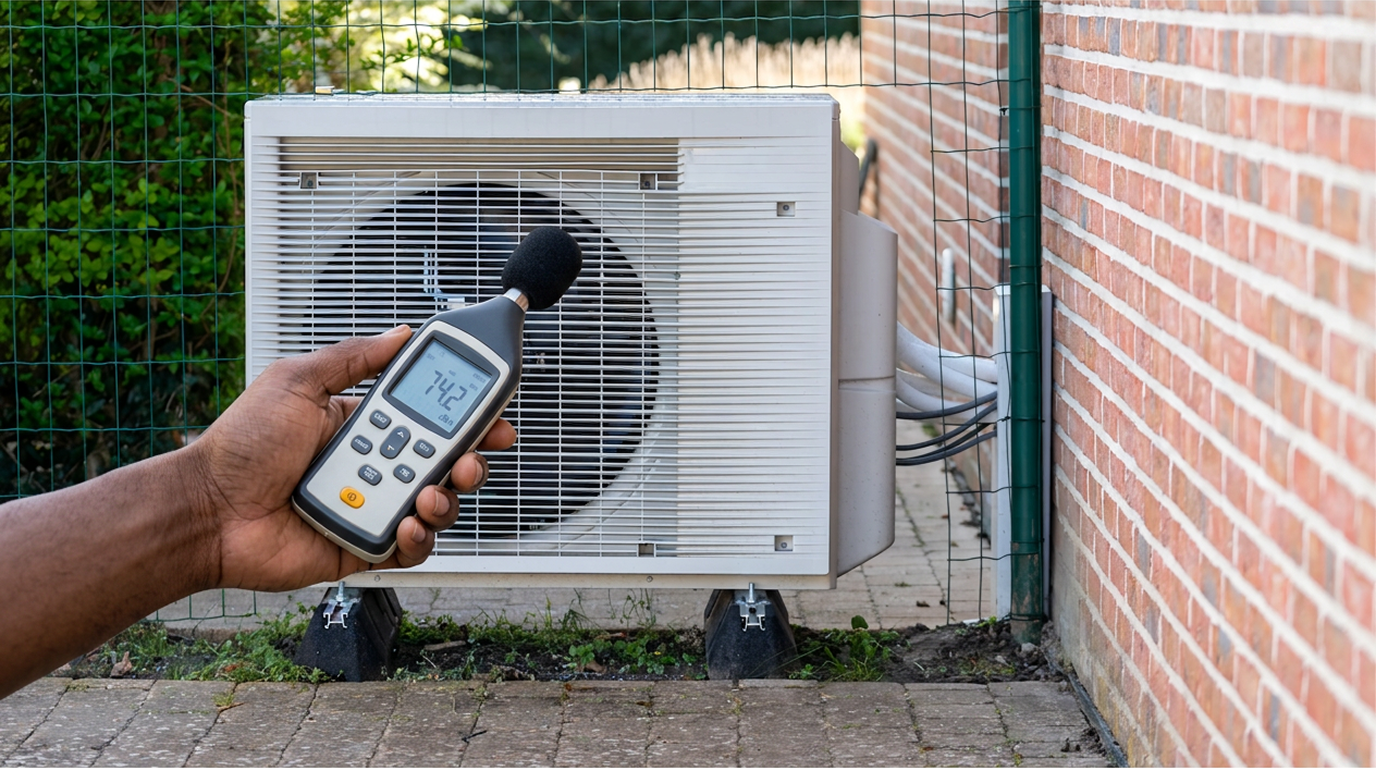
Most air source heat pumps operate at between 40 and 60 dB at one metre. In practice, the majority of modern UK-installed units sit comfortably in the 45–55 dB range during normal running.
Before going further, it's worth clarifying a distinction that trips up a lot of articles on this topic: the difference between sound power and sound pressure.
- Sound power (LWA) is the total acoustic energy a unit emits — the number you'll see on spec sheets and manufacturer datasheets, measured to EN 14511. It's a higher number.
- Sound pressure (LpA) is what you actually hear at a given distance. It's lower than sound power, and it's the figure that matters for planning rules and everyday experience.
When a manufacturer says their heat pump produces 53 dB, they usually mean sound power. The sound pressure at one metre from that same unit might be 40–45 dB. Most competitor articles don't make this clear — which is why numbers can seem inconsistent. Throughout this guide, we specify which measurement we're using.
What Does That Actually Sound Like?
Decibels are logarithmic, which makes them unintuitive. Here's how heat pump noise compares to sounds you already know:
| Sound | Level (dB) | Notes |
|---|---|---|
| Quiet library | 30 dB | Near silence |
| Fridge humming | 35–40 dB | The background hum you barely notice |
| Quiet ASHP at distance | ~40 dB | Well-sited unit, few metres away |
| Quiet suburban garden | 40–50 dB | Ambient background noise |
| Typical ASHP at 1m | 45–55 dB | Primary range for most UK models |
| Gas boiler firing | 50–60 dB | Similar to an ASHP — but indoors |
| Dishwasher running | 55–60 dB | Top end of ASHP range |
| Normal conversation | 60 dB | — |
The gas boiler comparison is worth pausing on. Boilers produce similar decibel levels to heat pumps — but because they're inside your home and you're used to them, you don't notice them. A heat pump is outside, which means even if levels are identical, it registers differently at first. In our experience, most homeowners stop noticing their heat pump within a few weeks.
A Nesta survey of UK heat pump owners found that 85% were satisfied with their heat pump's noise levels, often describing it as unobtrusive. Freedom of Information requests to local councils found that between 2020 and 2023, only 42 out of 124 councils that responded had recorded even a single noise complaint about a heat pump.
How Do Different Heat Pump Models Compare on Noise?
This is the section that no other guide has — because most articles rely on generic ranges rather than checking actual manufacturer specifications.
We pulled the figures directly from product datasheets and official press releases. Note that both sound power (LWA, the spec-sheet figure) and sound pressure (LpA, what you hear at distance) are listed where available:
| Brand | Model | Sound Power LWA | Sound Pressure LpA at 1m | Notes |
|---|---|---|---|---|
| Vaillant | aroTHERM Plus 5kW | 53 dB(A) | <30 dB(A) at 3m | Quiet Mark accredited; R290 refrigerant |
| Vaillant | aroTHERM Plus 10–12kW | 58–60 dB(A) | — | Larger units produce more noise |
| Mitsubishi | Ultra Quiet Ecodan 8.5kW | 58 dB(A) | 45 dB(A) | Well within PD limit; flagship quiet model |
| Samsung | EHS HT Quiet 8kW | — | 42 dB(A) | Exactly at PD limit; designed for tight sites |
| Samsung | EHS Mono R290 | — | ~35 dB(A) | New R290 range; among the quietest available |
| Octopus | Cosy 6 | 53.8 dB(A) | — | Third-party verified to EN14511 |
| Daikin | Altherma 3 | ~52 dB(A) | — | Industry-standard performer |
Sources: Vaillant aroTHERM Plus spec sheet; Mitsubishi Ultra Quiet Ecodan; Samsung EHS datasheet; Octopus Cosy 6 verified specs.
A few things stand out from this data. First, the Vaillant aroTHERM Plus 5kW is genuinely exceptional — under 30 dB at 3 metres is quieter than a library. It's Quiet Mark accredited and was specifically designed with terraced and semi-detached housing in mind. Second, the Samsung EHS Mono R290's ~35 dB figure represents the new frontier for residential heat pump noise. Third, even the loudest models in this table (58–60 dB LWA) translate to much lower sound pressure at real-world distances.
If noise is a particular concern for your property — a terrace, a home with close neighbours, or a bedroom window that faces the garden — ask your installer which model is specified and check the sound pressure figure, not just the sound power.
UK Noise Regulations: The 42 dB Rule Explained
Heat pumps installed under Permitted Development (PD) — meaning without full planning permission — must comply with a noise limit. The rule is:
The unit must not produce more than 42 dB(A) sound pressure level, measured at one metre from the nearest neighbour's habitable room window.
This is a sound pressure limit, not a sound power limit. Every MCS-certified installer is required to run a noise calculation as part of the installation process to verify compliance before sign-off.
What Changed in May 2025?
Until May 2025, there was also a distance restriction: heat pumps had to be installed at least one metre from the property boundary. This rule was removed by the government in May 2025 under the Town and Country Planning (General Permitted Development) (England) (Amendment) Order 2025.
This is a positive change. It gives installers more flexibility to position units in the optimal location for both efficiency and noise — particularly useful for terraced houses with limited space. The 42 dB noise limit itself remains fully in force.
What Changed in May 2026?
From 28 May 2026, the updated MCS 020 standard became the required certification framework for PD installations. The underlying 42 dB legal limit hasn't changed, but the calculation method has become more rigorous: the new method uses a 37 dB(A) input (sound power) rather than the previous figure, providing a more conservative and accurate prediction of real-world noise levels.
In practice, this means any MCS-certified installer working today is using the updated calculation. It's more stringent than before, which gives you more confidence that a compliant installation will stay within limits in real conditions.
What Does This Mean for Your Installation?
Nothing you need to manage yourself. Every Switch Together installation includes a full noise assessment as part of the home survey process. The installer runs the MCS 020 calculation, confirms compliance, and documents it as part of the MCS certification. You receive that documentation at handover.
Will You Hear Your Heat Pump Indoors?
For most homes: no. The outdoor unit is on the exterior of the building, walls attenuate sound significantly, and normal domestic background noise (central heating, appliances, conversation) is typically louder than what passes through.
The exception: if your living room or bedroom window opens directly toward the unit, you may hear it when the window is open. This is a siting consideration, not an inherent problem with heat pumps — a good installer positions the unit away from frequently opened bedroom and living room windows during the survey.
What About Heat Pump Noise at Night?
This is a specific concern that barely gets addressed anywhere, so let's be direct about it.
Heat pumps do run at night, particularly in winter when they're managing the heating schedule or maintaining cylinder temperature. If you're on an intelligent tariff like Octopus Agile, your system may be programmed to run more heavily during overnight off-peak hours.
The reassuring reality: modern heat pumps are quieter at low-demand overnight operation than at peak output. At night, background noise levels drop too — but so does the heat pump's output. Well-sited units positioned away from bedroom windows are not a sleep disturbance. The 42 dB permitted development limit applies regardless of time of day, so a compliant installation is compliant around the clock.
If night noise is a specific concern for your property, mention it to your installer at survey stage. Positioning the unit on the side of the house furthest from bedrooms is straightforward to plan for.
How to Reduce Heat Pump Noise
Siting and Installation
The single most effective noise-reduction measure happens before the unit is even switched on: where it's positioned.
Key siting principles that minimise perceived noise:
- Distance from windows — particularly bedroom windows and frequently-opened living room windows
- Anti-vibration mounts — reduce structure-borne hum that can transmit through walls and floors
- Avoid hard reflective surfaces — positioning against a brick wall that faces a neighbour's window increases perceived noise; angling away reduces it
- Acoustic fencing or screening — can be effective, but placement matters. Screening behind the fan discharge direction actually reduces airflow efficiency. Your installer can advise on the correct placement
- Correct sizing — an oversized heat pump runs harder and louder than necessary; undersized units run constantly at high output. Both are noisier than a correctly sized system running at moderate load
Switch Together's home survey includes a site assessment that considers all of these factors before confirming the installation plan.
If Your Heat Pump Is Already Installed and Noisy
Some noise is normal. Some noise is a signal to investigate. Here's how to tell the difference:
Normal sounds:
- Low hum or whirr during operation — the fan and compressor are running normally
- Clicking on start/stop — the compressor starting up or shutting down; normal
- Loud bang or thud in cold weather — this is the defrost cycle. When ice builds up on the outdoor coil in cold, damp conditions, the heat pump briefly reverses its refrigerant flow to melt it. The sound is sudden and surprising the first time you hear it, but it's entirely normal and lasts only a minute or two
Sounds worth investigating:
- Persistent buzzing — often caused by loose panels, screws, or vibration from the mounting surface. Check fixings and anti-vibration mounts
- Rattling — could be debris in or around the unit, or a loose component
- High-pitched screech — unusual and worth a service call; may indicate refrigerant or fan bearing issues
- Constant loud running — if the unit sounds louder than usual for an extended period, it may be working harder than normal due to a sizing issue, low refrigerant, or a dirty filter
For anything beyond loose panels, book an annual ASHP service — a professional will check refrigerant levels, fan operation, and electrical components as standard.
Frequently Asked Questions About Heat Pump Noise
Are heat pumps noisier than gas boilers?
No — and this surprises most people. A gas boiler produces 50–60 dB when firing, which is similar to or louder than most air source heat pumps. The key difference is that boilers are inside your home, and heat pumps are outside. Because you're already used to boiler noise as a normal household sound, you don't register it the same way. A 2023 Nesta survey found 85% of heat pump owners were satisfied with noise levels.
Can my neighbour complain about my heat pump noise?
They can complain to your local council's Environmental Health team. However, a heat pump installed by an MCS-certified installer that meets the 42 dB permitted development limit is well protected. The MCS noise calculation provides documented evidence of compliance. Nesta's Freedom of Information research found that councils received extremely few heat pump noise complaints between 2020 and 2023 — with most councils recording zero complaints in the entire period.
What is the quietest heat pump available in the UK?
The Samsung EHS Mono R290 (~35 dB sound pressure) and the Vaillant aroTHERM Plus 5kW (under 30 dB at 3 metres, Quiet Mark accredited) are among the quietest residential models available. The Mitsubishi Ultra Quiet Ecodan operates at 45 dB at 1 metre — well within the 42 dB permitted development limit at planning distances. Ask your installer to specify the noise figure for the recommended model before committing.
Why does my heat pump make a buzzing or clicking noise?
Buzzing usually points to vibration — loose panels, an insufficiently damped mounting surface, or pipework rattling against the wall. Check fixings and anti-vibration mounts first. Clicking on start and stop is normal compressor behaviour and not a cause for concern. A loud banging in cold weather is the defrost cycle — normal, brief, and automatic. Persistent or unusual loud noise warrants a service call to check refrigerant pressure and fan operation.
Can I get a heat pump if I live in a terraced house?
Yes. The Vaillant aroTHERM Plus was specifically designed and Quiet Mark accredited for densely built housing, including terraced streets. Samsung's EHS HT Quiet range is designed to sit exactly at the 42 dB PD limit. Good siting — typically on the rear of the property, away from neighbours' bedroom windows — resolves most concerns. Switch Together regularly installs heat pumps in terraced properties across the UK.
The Bottom Line on Heat Pump Noise
Heat pump noise is one of the most overstated concerns in the UK market — and once you've seen the actual numbers, it's easy to understand why.
To recap:
- Air source heat pumps typically produce 40–55 dB in normal operation — broadly comparable to a fridge or ambient garden noise
- Sound power (spec sheet) and sound pressure (what you hear) are different figures; always check which one you're comparing
- The quietest models produce as little as 35 dB at one metre (Samsung EHS Mono R290) or under 30 dB at 3 metres (Vaillant aroTHERM Plus 5kW)
- UK planning rules require heat pumps to stay below 42 dB at your neighbour's window — every MCS-certified installation includes a noise calculation to verify this
- 85% of UK heat pump owners are satisfied with noise levels (Nesta)
- The defrost cycle bangs in cold weather is normal — not a fault
- Good siting, correct sizing, and anti-vibration mounts handle the vast majority of noise concerns before they arise
If you'd like to understand what a heat pump installation would involve for your specific property — including where the unit would be sited and which model is right for your home — register for a free personal offer and we'll put together a tailored quote.